
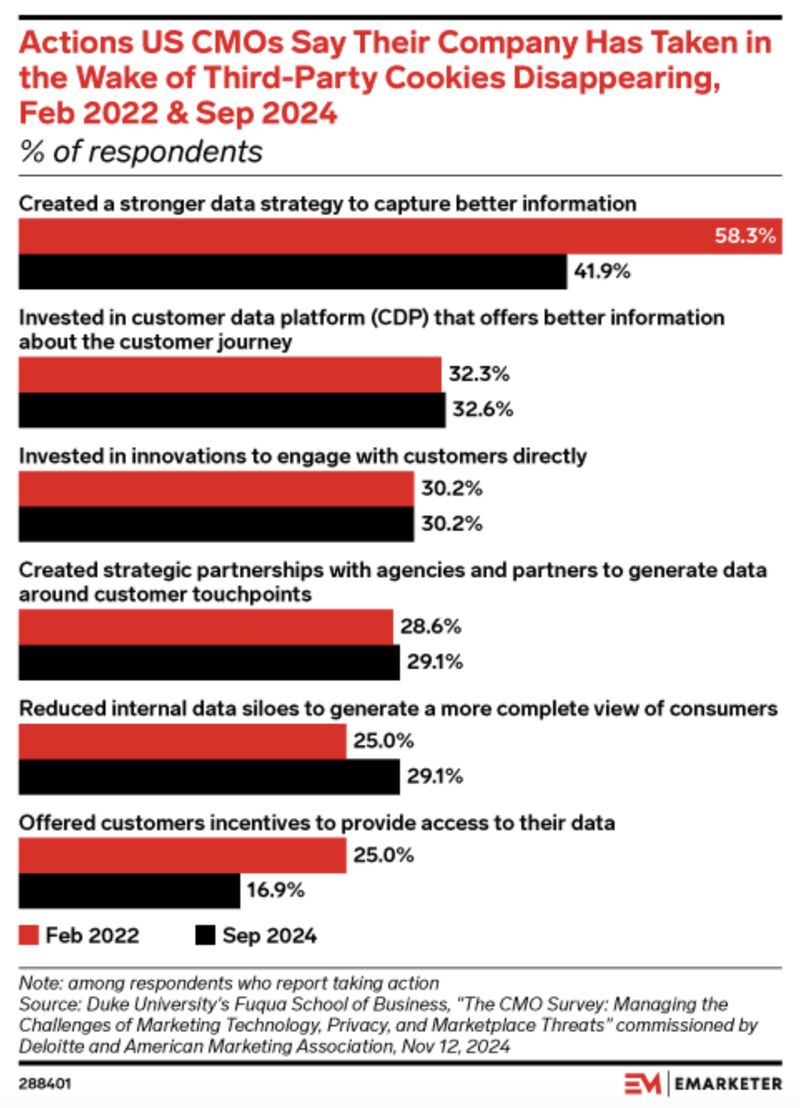
Do fewer Cookies = More CDPs?
Are you one of many marketers pouring money into standalone CDPs, hoping they’ll solve your data woes? Or are you the marketer asking, “Do I really need a CDP?” More often, I see marketers opting out of standalone solutions in favor of streamlining their vendor list and tech stack with providers like Braze, Iterable, or Zeta Global, which offer “built-in” CDPs to address data challenges.
🟢 When a Built-In CDP Is Enough
⦿ You need a streamlined way to manage and activate customer data for cross-channel campaigns.
⦿ Your data sources are limited and work well within the platform’s ecosystem.
Quick implementation and simplicity are priorities.
🟢 When You’ll Need a Standalone CDP
⦿ Your data is fragmented across multiple systems, including offline channels.
⦿ Advanced analytics and predictive modeling are core to your strategy.
⦿ Flexibility is critical—you want a centralized hub that feeds clean data to various tools.
🟢 The Players With Built-In CDPs
→ Optimove: Excels at customer lifecycle management, dynamic segmentation, and retention campaigns.
→ Iterable: Offers real-time data updates and strong cross-channel engagement for seamless customer journeys.
→ Braze: Focused on app-first strategies and real-time personalization.
→ Zeta Global: Advanced analytics and segmentation for enterprise-level campaigns.
Others include Salesforce Marketing Cloud, HubSpot, Klaviyo, and Adobe Experience Cloud.
🟢 Key Considerations
Built-in CDPs simplify workflows and save costs but can struggle with complex data or scalability. Standalone CDPs like Segment or Amperity might be better for businesses needing heavy-duty analytics or diverse integrations.
🟢 What’s Next?
If you’re leaning toward a built-in CDP, assess your data ecosystem. Will it scale? Does it integrate seamlessly? If not, explore standalone options that can grow alongside your needs. Don’t settle for a “just enough” solution if you’re building for the future.
Thank you, EMARKETER for the chart 😀




 Neil O'Keefe
Leave a comment